Defense Analysis Seminar -Korea (April, 2008)
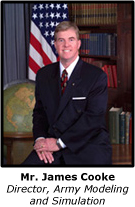
Mr. James Cooke, Director Army Modeling and Simulation
A transcript from keynote speaker: Mr. Cooke's presentation to the Defense Analysis Seminar (DAS).
This is a great time to be a modeling and simulation professional! Thank you for inviting me to this conference to say a few words about our profession of defense modeling and simulation, and about what’s happening to it in the United States.
The value of modeling and simulations is not only gaining increasing notice in the United States, it’s becoming a highly sought skill. Most banks and Wall Street firms rely on their closely held versions of models and simulations to give them an economic advantage in the marketplace. Five years ago, the Congress of the United States started a Modeling and Simulation caucus, or special interest group, so that the Congress can specifically track model and simulation investments across the government. Last year, President Bush signed into law recognition that modeling and simulation capabilities are a national critical interest technology. Our Congress just passed a bill that will give two hundred million dollars to a group of 64 American universities over the next five years towards research on key areas associated with modeling and simulations.
In January, I attended a meeting across the US government on Modeling and Simulation where the Federal Aviation Administration was briefing Congress on its plan to use supercomputers and netted models to eliminate passenger waiting times and plane congestion at airports. The Federal Reserve briefed how its more advanced models, in development, are going to allow it to take actions on the national monetary supply quicker with the same types of tools enjoyed by Wall Street, and this would reduce unemployment and inflation. The National Weather Service identified how its plans for advanced modeling would enable better, more accurate warnings about the expected size and path of hurricanes, so that the civilian population could evacuate in a timely and appropriate manner. Likewise, several other agencies briefed their beliefs in the immediate emerging value of their developing models and simulations. All of these organizations consider defense modeling and simulation to be in the lead in respective development and employment. Our challenge in defense is to live up to that expectation, and to meet the need to create always evolving and relevant models and simulations to meet the intent and aims of the government when defense forces are employed.
The exciting news is that there are many opportunities to create immediate and lasting impact. In past years, modeling and simulation might have been considered a fairly arcane type of magic, giant computers served by monks of data leading to recommended rankings of alternatives, or the generation of system unique training tools. In this generation, we’re moving models and simulation to take its place on the battlefield. By 2015, the way we do models and simulations today will appear as old-fashioned as a rotary dial telephone, and the integration of models and simulations into everyday operations will seem as natural to servicemen and women as today’s personal cell phone. Let me share with you three areas of fundamental change that are pushing us |


 PDF
PDF PDF
PDF