|
Exploiting Commercial War Games for Teaching, Training and Mission Rehearsal Exercises
David G. Gruenbaum
Mr. Gruenbaum is an Alion Science and Technology Senior Military Analyst supporting Department of Defense Training Transformation.
Teaching military history and art is particularly challenging because of the difficulty in communicating concepts of logistics, maneuver, and combat; because campaigns appearing predictable in hindsight were actually fraught with uncertainty (e.g. the German plan for the attack through the Ardennes in May, 1940); and Clausewitz’s “friction” of war is hard to convey. Further, the key concept of “how to think” is often better taught through problem-solving than by lecture. Lastly, commanders do not have many opportunities to deploy ground, air, or naval forces to gain familiarity with their capabilities, or the situation precludes the opportunity to do so, as in mission rehearsal exercises (MRE).
The main frame computer opened combat simulation programs as a new methodology for students of military affairs, but these also entail large monetary and technological commitments. However, an alternative exists in commercial off-the-shelf (COTS) simulation games which offer an expanding selection of titles covering a wide variety of battles, campaigns, and wars, from the tactical to the strategic level.
Thomas J. Willmuth encapsulated the realization of COTS’ promise based on his experiences as an Assistant Professor of Military Science teaching Army ROTC cadets the basics of tactics, and as a Command and General Staff College student, analyzing the value of using a COTS war game in communicating the fundamentals of combined arms forces, logistical constraints, and the complexities of campaign planning and operations.1 He documented the level of understanding students gained by playing a wargame scenario, presented a methodology for using games as a training tool, and noted the tremendous cost and time savings compared to a Corps Battle Simulation (CBS) exercise ($20-$60 per COTS game versus more than $100,000 in equipment and contract support for even a small CBS exercise).2
Since then, more COTS wargames have become available. In fact, the Army Homepage (www.army.mil/fcs/) offers a free download of a well-done computer wargame, Future Force Company Commander (F2C2), based on some of the equipment and capabilities of the Future Combat System. Below is an overview of some current offerings which trainers and leaders may find useful in teaching, training, and MRE.
Ground Combat COTS Games
Many games cover ground combat from the Seven Years’ War to contemporary conflicts, from the tactical level (fire teams to company-sized units) through the operational level (from company up to divisional-sized units) to the strategic level (armies, fleets, and air forces). Among tactical games are Danger Forward and Desert Rats, by Shrapnel Games (www.shrapnelgames.com); and Vietnam and Tour of Duty from HPS Simulations (www.hpssims.com). Shrapnel Games also publishes Armored Task Force (ATF), designed by an Active Duty Army officer, which resembles both the F2C2 and the JANUS simulation as a “real-time command” game in which units are in movement and combat unless the game is paused; other ATF series games are Raging Tiger, The Star and the Crescent (the Arab-Israeli wars), The Falklands War: 1982 and most recently Air Assault Task Force (which |
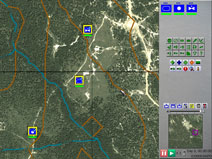
Screenshot of Air Assault Task Force
from Shrapnel Games
|

 PDF
PDF PDF
PDF