MS Header - Soldier collage
 
Main Page
 

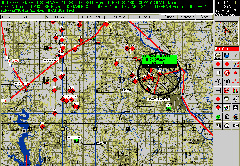
challenging feature ofthis series is the Campaign option, where players make strategic decisions and operational choices leading to tactical actions, which altogether create a “command decision” series of actions and counter-actions. The “Panzer Campaigns” series of games cover World War II from France ‘40 to Bulge ‘44,including such enormous campaigns as Tobruk ‘41, Moscow ‘41, and Stalingrad ‘42, across computer-generated 1:60,000 scale maps (the largest representing approximately 780 by 220 kilometers of terrain), with combat, combat support and service support units (usually battalions), which can number into the thousands. Since each turn represents two hours of operations and combat, these games lend themselves to team play over long periods. The “Modern Campaigns” series similarly models the Mideast ‘67 (including scenarios from the 1956 and 1973 wars), Fulda Gap ‘85, North German Plain ‘85 and Korea ‘85 situations on computer-generated 1:100,000 scale maps, in turns representing three hours of time. Decisive Action is also published by HPS, which is a simulation designed by a retired U.S. Army officer for teaching divisional and corps-level tactics at the U.S. Army’s Command and General Staff College. In Decisive Action players plot maneuvers which are mutually resolved in a pulse representing two hours of time, and must pay attention to units’ logistical situation; this game models well the “footprint” and weapons range rings of contemporary forces. The powerful scenario editor and capability to create scenarios from scanned or down-loaded maps permit quick MRE construction.

The First Blitzkrieg, a game by HPS Simulations covering the invasions of Poland, Denmark, and the 1940 German attack against the Allies, in turns representing 48 hours of movement and combat on 1:600,000 scale maps, is the first of a strategic level series of games entitled “World War II in Europe”. Matrix Games presents War in Russia, a game of movement and combat with units representing divisions and corps, across a 1:2,000,000 scale map in turns representing one week of time, as a free download from their website.

Naval Combat Games

Tactical and operational naval games cover single ship or individual aircraft up to fleet operations. HPS has published three games of historical naval actions: Tsushima (1905), Jutland (1916) and Guadalcanal (1942-43), in which ships’ movements are plotted and operations performed in a real-time setting. Sonalysts Combat Simulations (scs.sonalystsgames.com) has published Dangerous Waters, an extremely detailed and very complex game based on U.S. Navy shipboard command and aerial combat missions. Matrix has published Harpoon III, a computer version of the renowned board game of naval task force operations.

Air Combat Games

Air combat games of greatest utility are operational level simulations of air mission planning and execution. Matrix has republished Talonsoft’s Battle of Britain and Twelve O’Clock High: Bombing the Reich, two games in which players must plan either the bomb group routes and targeting of key sites, or their aerial defense in turns representing one day of operations; both games were extensively researched and are highly challenging and instructive. HPS Simulations recently published Defending the Reich, a game of the 1943-44 RAF night bombing campaign, similar to the preceding two

Screenshot of Decisive Action with control panel
Screenshot of Decisive Action
from HPS

games. HPS also publishes Modern Air Power: War Over Vietnam, a simulation of missions in the bombing campaign against North Vietnam; the Air Force Academy uses a version of contemporary aerial conflict for teaching air operations to its cadets.

Joint Operational and Strategic Level

Uncommon Valor, Matrix Games, covers the Southwest Pacific area campaign from May 1942 to December 1943, in one-day turns, modeling ground, naval and aerial combat on a 1:3,000,000 map of the Southwest Pacific. War in the Pacific, also by Matrix Games, is similar to Uncommon Valor but covers the entire four years of war in the Pacific Theater as single game. Gary Grigsby’s World at War and Gary Grigsby’s World at War: A World Divided, both by Matrix Games, are the original release and updated simulation of all of World War II in a system which allows for command of five separate forces (Germany, Japan, USSR, China and the Western Allies) mobilizing national resources to engage in sea, land and air campaigns.

Conclusions

Willmuth concluded from his study that “…simulations…offer insights, perspectives and opportunities for the serious student unmatched anywhere else.”3 He went on to state that the failure “…to harness the power, speed, and three-dimensional insights of a computer simulation for the study of history seems a terrible waste of assets.”4 Kerry MacIntyre earlier concluded that the concepts of FM 22-100 Army Leadership could be taught with the use of COTS wargames.5 Jeffery M. Shoemaker also concluded COTS wargames could be used to convey concepts of Battlefield Operating Systems, and developed an evaluation criteria matrix to assist in COTS wargame selection.6 These conclusions remain relevant, evidenced by the presentation of F2C2 as a free download, but today’s suite of COTS simulations is greater and we can anticipate those of the future will be even better, for even more powerful and portable computers.

Page 1


1 Willmuth, Thomas J.; MAJ, AV; THE STUDY OF MILITARY HISTORY THROUGH COMMERCIAL WAR GAMES: A LOOK AT OPERATION CRUSADER WITH THE OPERATIONAL ART OF WAR. Fort Leavenworth: USACGSC, 2001.

2 Willmuth, op cit., pg. 8.

3 Willmuth, op cit., pg. 90.

4 Willmuth, op cit., pg. 92.

5 MacIntyre, Kerry; Major, Ordnance Corps; Analysis in the Utility of Commercial Wargaming Simulation Software for Army Organizational Leadership Development.  Fort Leavenworth: USACGSC, 2000; pg. 48.

6 Shoemaker, Jeffery M.; MAJ, USA; THE APPLICATION OF OFF-THE-SHELF MILITARY SIMULATIONS TO TRAIN DECISION MAKING AND TEACH TACTICS.  Fort Leavenworth: USACGSC, 2003.

Submit article for publication

Printable PDF Version

     
Headquarters Department of the Army
Office of the Deputy Chief of Staff, G-3/5/7, ATTN: DAMO-MSP
Simulation Proponent Division
400 Army Pentagon • Washington, DC 20310-0400
Phone: 703-601-0005 • FAX: 703-601-0018
FA57 & CP36 Logos