|
Joint Master Scenario Event List Tool
MAJ Jerry A. Hall
MAJ Hall is a Simulation Operations officer assigned to the 94th Army Air and Missile Defense Command (AAMDC), Fort Shafter, Hawaii
“Where did the yellow sticky for today’s key event go?”
For anyone involved in exercise scenario development and execution in the past, the sinking feeling in the stomach that follows the above question holds special meaning! Development of a Master Scenario Events List (MSEL) in the past has often revolved around butcher paper on the wall (or perhaps at best an Excel spreadsheet) covered with hundreds or even thousands of Post-It notes used to portray planned scenario events.
The Joint Master Scenario Event List (JMSEL) Tool allows exercise scenario development and execution in an automated environment that precludes loss of those pesky yellow stickies. The JMSEL tool is a web-based application that provides enhanced dynamic exercise planning support. The JMSEL provides a tasking and suspense functionality with several capabilities such as; generating exercise events, providing source documents that task the training audience, and handling administrative actions to pass the suspense and action material from the originator to those tasked in real time. An embedded calendar facilitates tasking and suspense management.
Sample JMSEL Tool MSEL Status display.
BACKGROUND
The JMSEL Tool had its genesis at United States Pacific Command (USPACOM). The Booz-Allen staff at the Exercise Simulation Center Pacific began development of a Distributed MSEL Management System (DMMS) in 1998. The DMMS was originally a Microsoft Access database system that evolved into a web-based MSEL management tool. Subsequently, the Joint Staff began searching for a MSEL tool to complement the Joint Training Information Management System (JTIMS). The Distributed MSEL Management System evolved into the tool currently in use today, JMSEL Tool version 2.6.
OVERVIEW
The JMSEL Tool provides a comprehensive, integrated tool for full life-cycle development of scenario-based exercises and games supporting the spectrum of |
training. This can range from small single-service exercises to large, distributed multi-lateral exercises. The system supports exercise design for Department of Defense organizations and services, as well as other agencies. The JMSEL supports both unclassified exercises on the NIPR and classified (SECRET level) exercises, SIPR and CENTRIXS networks. The JMSEL Tool is designed to support geographically dispersed control organizations in a collaborative, data-sharing environment while limiting access to scenario events by the training audience. Developed to support strategic and operational exercise development requirements, JMSEL supports a wide variety of functional areas. Users access the data via client/server and web-based user interfaces. JMSEL provides a robust exercise planning capability that supports the exercise life cycle by: assisting users with identifying tasks and objectives, developing a key event storyboard, expanding events and building detailed implementation documents (e.g., scripts and messages) and analyzing event development progress.
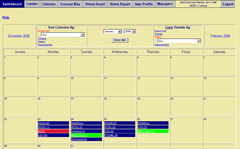
Sample JMSEL Tool Calendar Display
JOINT EVENT LIFE CYCLE (JELC) MANAGEMENT
JMSEL supports all phases of the JELC: Requirements, Plans, Execution and Assessment.
The JMSEL Tool supports the Requirements Phase by assisting with concept development. During this phase, training audiences are identified and Mission Essential Task Lists (METL) and Training Objectives are developed. Once these are established they can be imported into JMSEL from JTIMS (USPACOM can import via URL; all others via export/import of xml files) or manually entered for those commands not using JTIMS.
The JMSEL Tool supports the Plans Phase by allowing collaborative development of key concepts and events with supporting themes, storylines and threads. Master scenario events created can be associated with training objectives and themes to allow them to be searched, sorted and linked. Archived data can be imported from other exercise Master Scenario Events (MSE’s) to streamline the creation of event. Tailored reports can be generated to allow analysis of how created events support different training objectives and themes. Page 2 |


 PDF
PDF PDF
PDF