Simulation Operations Professional Course #08-001 Completes Training at US Army Topographic Engineering Center
Richard Mackey
Richard Mackey is an Alion Science and Technology senior military analyst supporting the Simulation Proponent Division
Eighteen government and contract staff from the national capital region and other agencies across the country completed the Simulation Operations Professional Course (SOPC) at the US Army Topographic Engineering Center (TEC), Alexandria, VA during the period 25 February – 7 March 2008. The SOPC is sponsored and presented by the Simulation Proponent Division, Modeling and Simulation Directorate, Office of the Deputy Chief of Staff G3/5/7, Headquarters, Department of the Army as part of its civilian modeling and simulation (M&S) professional development and education program. This tailored variation of the SOPC was comprised of two one-week training modules consisting of forty-hours of instruction each. The SOPC is offered to Department of Defense military and civilian personnel who work in or indicate an interest in the area of modeling and simulation (M&S) with a primary focus on government M&S professionals within the Career Program 36 (CP36). The two-week course, hosted by Dr. J. David Lashlee, Associate Technical Director of the Topographic Engineering Center, provided the participants an opportunity to receive the latest M&S instruction and provided them information on the various simulation and stimulation tools that are available and being used to support operational requirements.
The US Army Topographic Engineer Center (TEC) is one of seven subordinate laboratories and activities of the US Army Engineer Research and Development Center (ERDC), US Army Corps of Engineers. The TEC’s mission is to provide warfighters with superior knowledge of the battlefield and to support the nation’s civil and environmental initiatives through research, development, and the application of expertise in the topographic and related geospatial sciences. Their primary focus is in the areas of imagery and remote sensing, geospatial information and services, network-centric warfare, and joint geospatial enterprise services (J-GES) to support the warfighter and the demands of the contemporary operational environment. One of the highlights of the SOPC was a tour of TEC’s facilities and the opportunity to observe some of the M&S initiatives and tools TEC is using to support their research, development, and acquisition decisions.
|
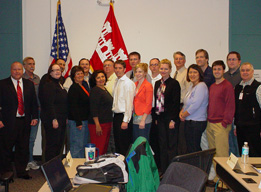
Members of the SOPC #08-001 pose for their SOPC completion photo. Mr. Roger Samuels, (far left), Chief of the Simulation Proponent Division, presented the course completion certificates to the assembled group.
|


 PDF
PDF PDF
PDF